


How to revise for science GCSEs: A teacher’s brain-based guide
Most students put in the hours but still forget the content. Experienced science department leader Alaistair Heys breaks down the neuroscience behind effective GCSE revision, covering encoding, consolidation and retrieval with actionable, classroom‑ready strategies.
What’s the science behind how to revise for GCSE exams? Experienced department leader and teacher of science, Alaistair Heys shares how the brain takes in information, and perhaps more importantly, how it retains information. He also provides some real examples and strategies to use with your students in the run up to mocks and the official exams when the time comes.
Many students spend a lot of time and effort revising, yet it’s clear they remember far less information than they - and you - expect.
It’s not because they aren’t trying, but because many common and traditional revision techniques do not capitalise on the way the brain retains information.
Students put lots of effort into reading and highlighting notes, or watching revision videos online, but there are better ways they can make their revision even more effective - and it might be worth sharing this information with them sooner rather than later.
What process should the brain go through for effective revision?
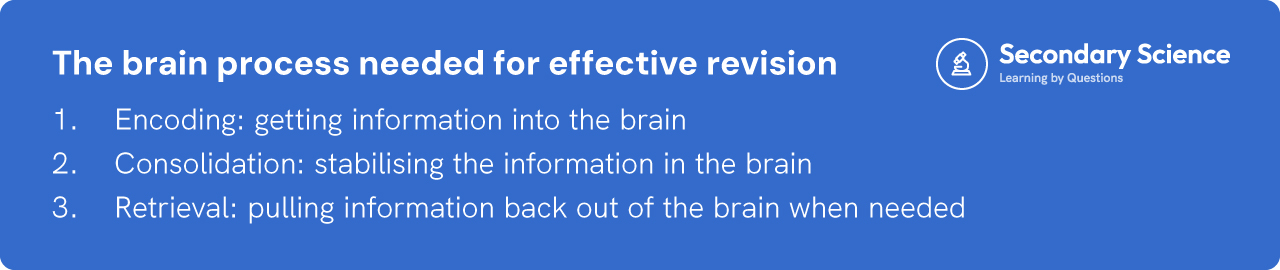
To revise effectively, we need to understand how information moves through the brain and into our long term memory. This process can be simplified to the following three stages:
1. Encoding: getting information into the brain
2. Consolidation: stabilising the information in the brain
3. Retrieval: pulling information back out of the brain when needed
How to revise for science effectively
Through the model of encoding, consolidation and retrieval, here’s how to revise for science more effectively.
Using the encoding stage to improve revision
Encoding is the process of turning what you see, hear or read into a mental representation that the brain can store.
Encoding does not happen efficiently through simply reading or listening to information. Information enters the brain best when some effort is made to transform the way that information is represented. When encoding isn’t effective, a large percentage of information revised might be forgotten and lost before the consolidation part of the revision process is completed.
Here are two examples of ways that students can improve this part of the revision process.
Make every piece of information a “but why?”
There are a lot of facts that students need to learn in GCSE science, but learning facts in the form of statements does not involve a lot of ‘transformation’. However, turning facts into a question is a very simple, yet powerful trick to help information enter our brain.
For example:
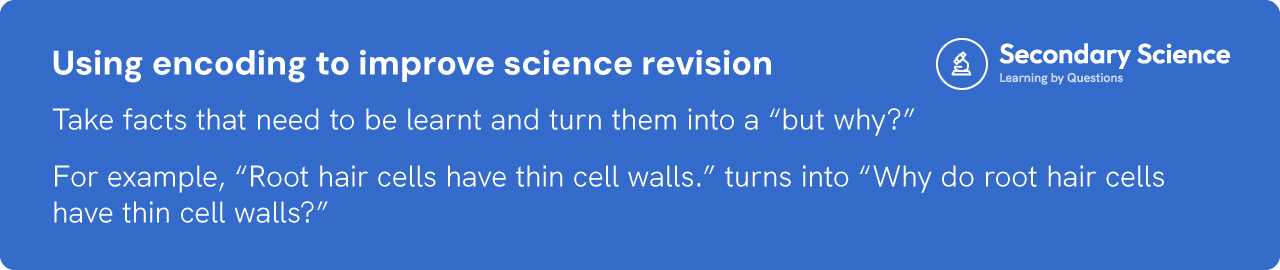
“Root hair cells have thin cell walls”
can be turned into
“Why do root hair cells have thin cell walls?”
Learning the ‘question’ rather than the ‘fact’ is an effective way of getting the ‘fact’ into the brain. Students may or may not at this point have a full understanding to the answer to this question, but they will be far more likely to remember the fact contained within it (that root hair cells have thin cells walls).
The reason this works is that questions are more meaningful, and the brain attempts to connect them to existing knowledge. This really pays off during the consolidation part of the revision process.
If possible, support the students in creating questions from facts by themselves. This forces their own brain to transform the information they are trying to review.
Convert information into tables, or associate them with images.
Mind-maps and flashcards have long been a revision favourite, but they become far less effective if the student is simply using them to re-write statements. Where possible, students should be encouraged to associate statements and information with images or data tables that they create themselves. These images could be simple, labelled diagrams, small flow charts, or something more abstract. The important thing is that the student is thinking independently about the image they want to create. This is another powerful yet simple example of how a student’s brain must transform the information they are trying to learn.

Encoding revision strategies to avoid
The following is a list of revision techniques often used by students (and sometimes encouraged by teachers!) that wont help embed information at the encoding stage of revision.
Reading notes over and over
Highlighting text
Copying text word for word with no transformation
Watching revision videos without pausing, making notes etc
Using the consolidation stage to improve GCSE revision
Once the process of encoding has occurred, the brain must stabilise the new memory traces. But information is stored in different parts of the brain during consolidation. The same piece of information can also be stored in multiple parts of the brain depending on how it has been represented in the brain.
For example, words and associated sounds are stored in the temporal lobe, images in the occipital lobe, and information that links to other experiences and past learning will be spread across multiple locations on the cerebral cortex.
For this reason, consolidation is not something students can actively do in the moment, like answering a question. But they can create conditions for it to happen more effectively.
Mix up the subjects and topics being revised
Most students will dedicate themselves to revising one subject at a time when revising. But consolidation of information is more effective when the brain has to discriminate between different types of information.
In a single revision session, encourage students to utilise 25 minute blocks for biology, chemistry and physics respectively. That way, the brain has to work harder to pull up the right schema and that extra effort works as consolidation.
Prioritise sleep
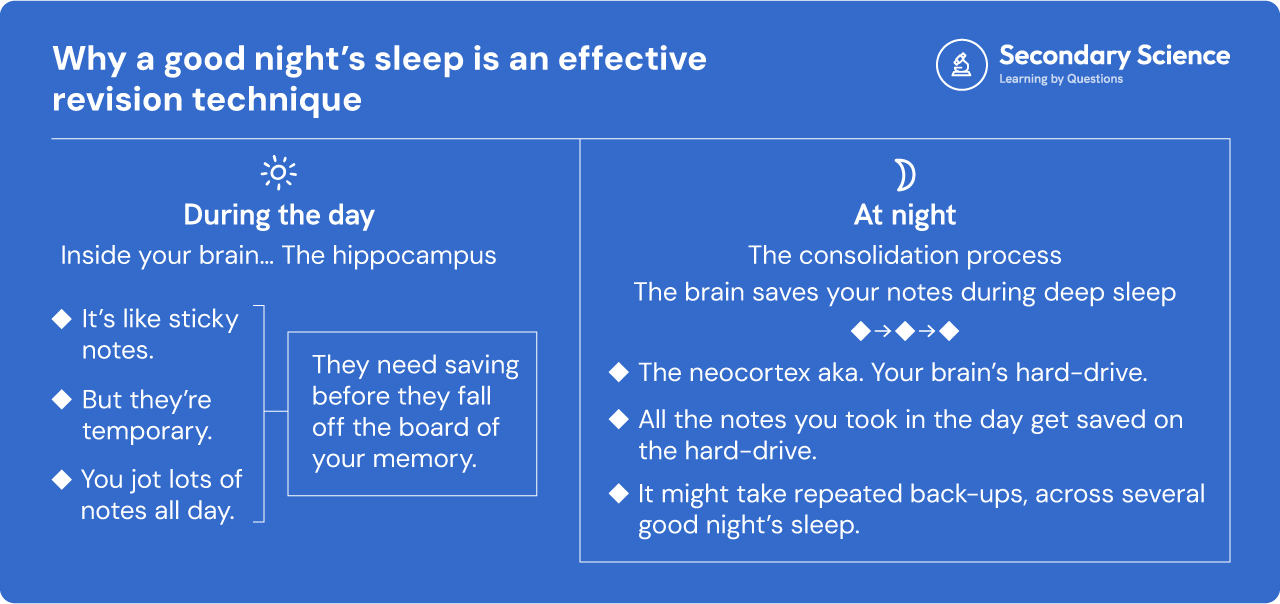
Consolidation takes time, and occurs most intensely during sleep! Late night cramming can be useful in the short term, but if we want to retain that information for the long term, a good night's sleep is the key. It might help to explain to students the hippocampus to neocortex transfer to help them understand the importance of their sleep in their GCSE years.
Think of the hippocampus as a busy whiteboard, and the neocortex as the library archives. During revision, students scribble facts onto the whiteboard. But unless those facts get copied across to the library, a process that happens primarily during deep sleep, they get wiped clean. Consolidation is that copying process. It doesn’t happen instantly; it requires repeated replays across several nights. That’s why a good night’s sleep after a revision session is non‑negotiable, and why spacing revision over weeks beats an all‑nighter every time.
Use wakeful rest after revision
After a block of revision, students should be encouraged to give their brain time to replay and strengthen new pathways. Silent reflection or a quiet walk outside are great ways to give the brain time to mull over the information its just received.
Using retrieval for effective science GCSE revision
Once information has been stored in the brain, it does not necessarily stay there. The ‘forgetting curve’ shows how retention decreases over time, and also how retention can be improved by regular recall.
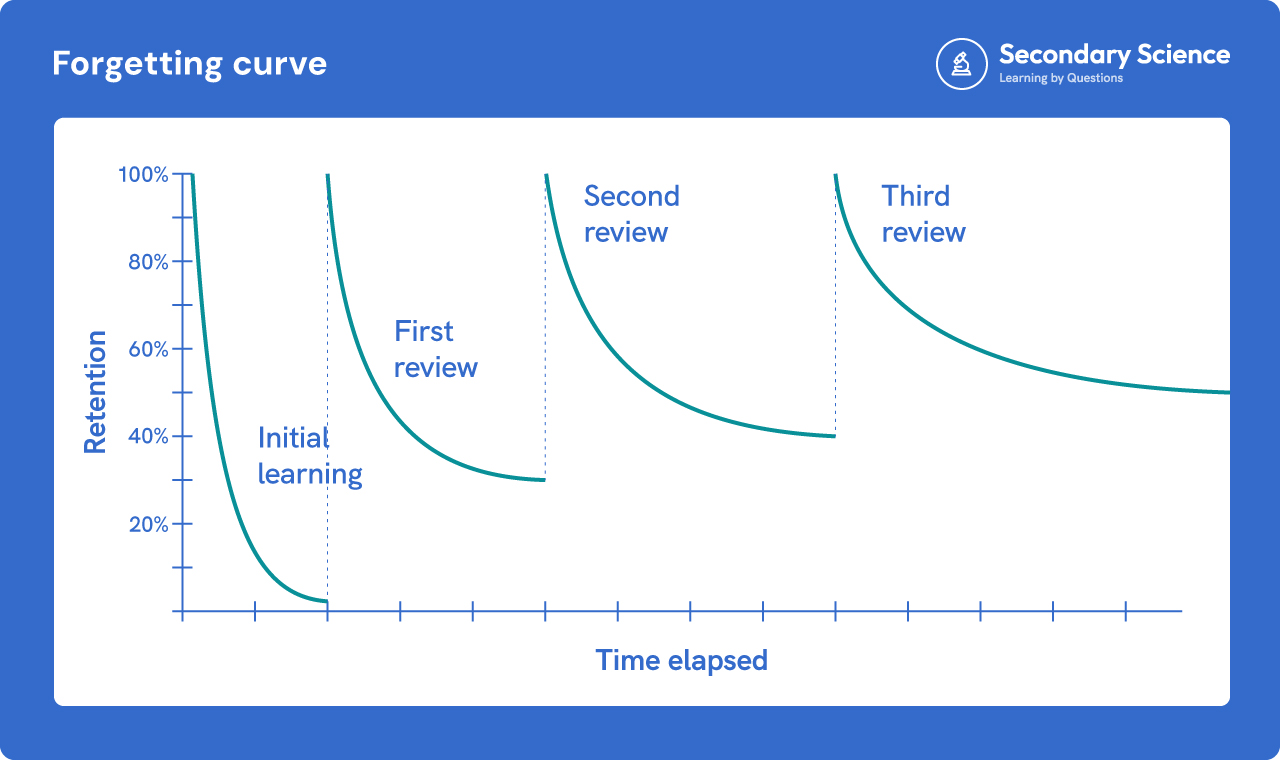
Recall becomes more effective if:
The information is recalled actively.
Recall is spaced out over a long period of time.
What is active recall and how can it be used to revise science effectively?
It can be tempting to refresh our memories by simply re-reading revision notes or re-watching revision videos. This can be moderately effective in the short term, but in order to boost long term retention, active recall is the key.
Active recall involves forcing the brain to recall information, rather than just repeatedly presenting the brain with that same information.
One great active recall technique can be to create mind-maps and flashcards from scratch, without the help of text books or revision notes.
Only once the mind-map has been completed should the student then cross check it with their revision notes to make sure nothing has been missed.
Repeating this process once every two or three weeks over a period of six months is incredibly effective for securing long term retention of information, which is why getting to grips with how to revise science effectively early in their studies might be more lucrative for everyone involved.
After more tips for effective revision? Read our blog 8 tips to teach your students how to revise for GCSE science that reveals practical tips for when they're in the thick of it.